Florida's #1 Citrus-Producing County
Polk County sits within "The Ridge" — the historic sand-ridge citrus belt running through Central Florida, prized for well-drained soil and a modest elevation advantage that offers slightly better frost protection than the surrounding flatlands. The Ridge is the ancient, elevated spine running north-south through the middle of the Florida peninsula, formed as a chain of ancient barrier islands from when sea levels were far higher — real geology underlying real agriculture. Polk County is Florida's #1 citrus-producing county: for the 2024–25 season, it led the state with 3.79 million boxes of citrus, ahead of Highlands County (2.89 million), DeSoto (1.37 million), Hardee (1.30 million) and St. Lucie (1.27 million) — together, these five counties account for roughly three-quarters of Florida's total citrus output.
"Florida's Citrus Capital"
A March 2024 public-radio report explicitly called Polk County "Florida's citrus capital," and noted that in 2023, more people moved into Polk County than into any other county in the entire United States — over 29,300 net new residents that year, drawn largely by its position between two expensive metros, Tampa and Orlando, while remaining comparatively affordable. That growth wave sits directly alongside the county's citrus heritage rather than replacing it — working groves, agricultural land and new residential development increasingly exist side by side across Polk County today.
A Deep Local Citrus History
Polk County's citrus story runs back further than most current growers. The Marsh Seedless Grapefruit — a commercially important variety still grown today — originated in Lakeland itself in 1887, a genuinely significant moment in Florida citrus history. That history is part of why grove ownership and agricultural property across Polk County carries real generational weight for a lot of local families, not just a modern investment.
What an Agricultural Property Cleanout Actually Involves
A working or formerly working citrus grove, or any rural agricultural property across Polk County, tends to generate debris a typical suburban cleanout never touches — old irrigation equipment and piping, damaged or diseased trees removed during grove maintenance, packing-shed or outbuilding contents during a property transition, fencing, and equipment shed debris. None of that is unusual for us, but it's worth describing specifically when you call, since agricultural debris sometimes needs to be handled differently from general household or construction waste depending on what it is.
Grove Maintenance vs. Full Land Transition
There's a real difference between routine grove maintenance debris — pruned or diseased tree removal, irrigation repair debris — and a full agricultural property transition, where an entire grove or parcel is being cleared for redevelopment, replanting, or a change in use. Routine maintenance tends to generate smaller, more predictable loads; a full transition generates significantly more volume and often mixes vegetative debris with structural material from packing sheds, fencing or old equipment.
Sizing for an Agricultural Property Project
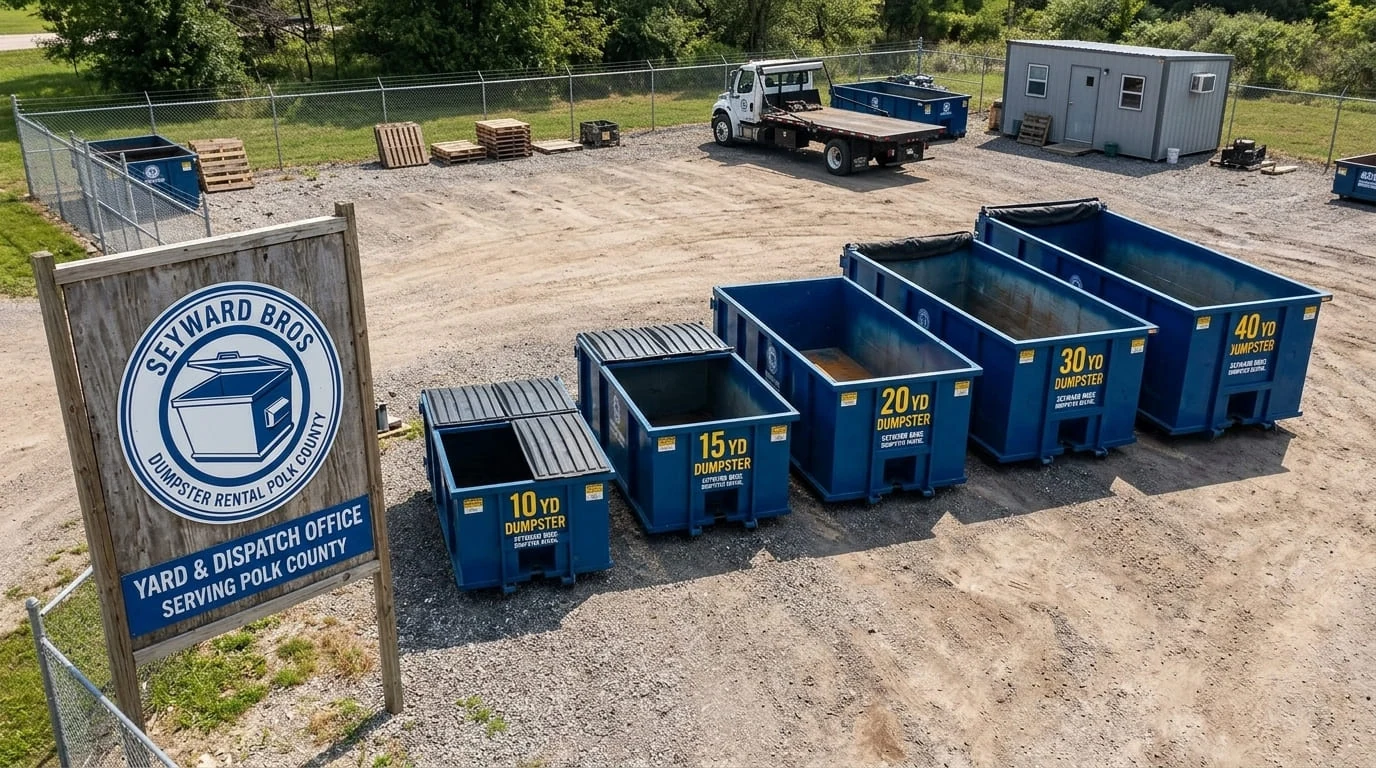
Routine grove maintenance or a smaller cleanout often fits a 15 or 20 yard. A larger property transition — clearing a significant portion of a grove, removing an old packing shed, or a full agricultural-to-residential land change — more often calls for a 30 or 40 yard, sometimes with multiple containers rotating through as the project moves across the property.
Whether you're maintaining a working citrus grove, transitioning agricultural land, or clearing an outbuilding on a rural Polk County property, call (863) 457-3737 and describe the project. We'll size the container to match, priced flat-rate based on the size you need, the debris type, and how long you keep it.